I have editorialized (on and off this blog) before on my dislike of the wedding industry; how elements of it are insane (buying a super expensive new dress to wear once?), unnecessary (spending a thousand dollars on a cake?), and unnecessary (registering for stuff you will never use --- Chip N Dip anyone?).
So when we got married last Sunday (YES! We got married!), we decided to look at all of the wedding "norms" through a fresh lens and decide what to take and what to leave.
We had been to a few friends' weddings where they requested donations to several non-profits instead of gifts, and thought that was a great idea. This wasn't an entirely unselfish decision, but largely came out of the fact that we don't need anything. We are both 30 years old, and have enough stuff already. It wasn't as if we didn't do anything in our house before we decided to get married. We have all of the kitchen, bedroom and bathroom items we could need. And when we do need something, we do what most people do: budget for that item and buy it getting full satisfaction after working toward that financial goal. A wedding registry may make sense for people who don't have a lot of the things they want, but we weren't in that situation.
So, instead of registering for a new coffee maker (we have one), a gravy boat (while we don't have a "gravy boat" per say, we do have other vessels that could serve as one, should we ever eat gravy), new wine glasses (Freecycle or Craigslist, anyone?) or even a Chip N Dip, we decided to ask guests to donate to causes that we care strongly about:
DC Vote: As tax-paying residents of Washington, DC, we are not afforded the rights that every other U.S. citizen enjoys: voting representation in the House of Representatives, the U.S. Senate and local control of how our tax dollars are spent. DC Vote is working to help us, and our neighbors, become full citizens.
Human Rights Campaign (HRC): Just by luck, we are allowed to get married. We also live in Washington, DC which recently legalized gay marriage. HRC is working toward equality for all across the U.S., and we support their efforts so every person, no matter their sexual orientation, can enjoy equal protection under the law.
Humane Society of the United States (HSUS): HSUS works tirelessly to advocate for those that do not a voice -- whether they are in factory farms, dog fighting rings, or killed for their fur. We support the great work they do in communities across the U.S. and on Capitol Hill to improve the lives of our furry friends.
Mentoring Today: Mentoring Today provides mentors for teenage boys in DC who will be transitioning from incarceration back into the community. Mentors meet with the teenagers in the months before they are released, and continue their friendship when they are back in the community, helping them access services and fulfill their goals.
In addition to our commitment to these causes, we essentially have enough.
There is a great story about Kurt Vonnegut, author of Slaughter House Five, talking to Joseph Heller, author of Catch 22, at a wealthy hedge-fund manager's house. The story goes that Vonnegut asked Heller if he was bothered that the hedge-fund manager made more than he did, even though he wrote one of the great novels of our time? And Heller responded that he had something the hedge-fund manager will never have: Enough.
But our thought process goes beyond what we need and don't need. The truth is that Americans have too much stuff. We buy new stuff, discard it way too soon, and buy newer stuff. And where does this stuff go? In our land, oceans and air. Check out this great video about The Story of Stuff:
This video changed my way of thinking about my consumerism. And I am hopeful that a lot of these most-important causes on our wedding registry will benefit from that!
Friday, July 8, 2011


Wednesday, June 29, 2011
Our local, humane wedding
By far, I think the best part aspect of planning our wedding has been the food. It was a way to turn my passion for humane living into something real.
Here is a rundown of all the cool things we are doing.
Food
Most importantly, our wedding -- and all of the noshing surrounding it -- will be entirely humane and vegetarian. We did a lot of research to find places that could accomodate these needs and vendors who understood why it was important to us.
Eat & Smile is catering our wedding. Oliver, the owner and chef, buys only local food from farmers markets in the DC area. We are not entirely sure what he is going to serve yet, but he gave us a list of food that is usually in season now. Whatever is fresh he will make. We absolutely loved his food during our tasting and cannot wait to eat at the wedding. Oh, and we will eat, contrary to what people say about the bride and groom not eating at their own wedding.
Whole Foods is catering our rehearsal dinner. Due to the fact that we cannot source the cheese there, we are doing a mostly vegan dinner. We are having southwest jicama salad, really garlicky kale, hummus dips, two kinds of tofu, garden hummus wraps and pasta salad. Check out Alex at our tasting:
Here is a rundown of all the cool things we are doing.
Food
Most importantly, our wedding -- and all of the noshing surrounding it -- will be entirely humane and vegetarian. We did a lot of research to find places that could accomodate these needs and vendors who understood why it was important to us.
Eat & Smile is catering our wedding. Oliver, the owner and chef, buys only local food from farmers markets in the DC area. We are not entirely sure what he is going to serve yet, but he gave us a list of food that is usually in season now. Whatever is fresh he will make. We absolutely loved his food during our tasting and cannot wait to eat at the wedding. Oh, and we will eat, contrary to what people say about the bride and groom not eating at their own wedding.
Whole Foods is catering our rehearsal dinner. Due to the fact that we cannot source the cheese there, we are doing a mostly vegan dinner. We are having southwest jicama salad, really garlicky kale, hummus dips, two kinds of tofu, garden hummus wraps and pasta salad. Check out Alex at our tasting:

The pastry chef there is using only Organic Valley milk, butter and eggs for any in-house dessert items.
Our morning-after brunch is being hosted by Rosemary's Thyme, an awesome restaurant in DC. I couldn't find a good breakfast place that was local, humane and affordable. But then I thought about Rosemary's Thyme. They always seem to be doing something cool. For instance, they host a free neighborhood Thanksgiving that includes a clothing drive. So I thought I would call and see if they would cater our breakfast using all local farmers.
They were more than happy to help, and it was so much fun going to the farmers market with Evin to have her meet the vendors and go over the menu. We are using Creekside Farm for eggs, Keswick for cheese, and milk and cream from Clear Spring Creamery. (We were going to use Blue Ridge, but they pulled their items once I asked about the farm they get their dairy from... More on that when I have time to write about something other than the wedding.)
Booze
Alex went on the hunt for local booze. We are getting local beer from Heavy Seas (Baltimore, MD) Flying Dog (Frederick, MD), and Port City Brewing (Alexandria, VA). Only some of the wine is local, and it's from Horton Vineyards in Gordonsville, VA.
And Alex made to sure to get as much of the liquor from union shops as we could, such as bourbon from Knob Creek, rye whiskey from Old Overholt, and rum from Mount Gay.
Stay tuned for pics of the awesome food!
Thursday, June 23, 2011
Questions for Blue Ridge Dairy
UPDATE (1pm ET, FRIDAY JUNE 24th): I spoke with Ann at FRESHFARM and she told me the name of the farm. After doing some reading online, they appear to be a small, diversified farm raising dairy cows, chickens, and livestock. I emailed them to ask about tail docking, number of cattle on the farm and housing conditions. Will let you know what I hear back, but this is good news so far!
**********
When I first started this humane food adventure, I was meticulous about asking all of the dairy and egg farmers at farmers markets a series of questions. In fact, it was roughly a year ago that I wrote about my first encounter with Blue Ridge Dairy, a cheese vendor whom I have grown to depend on for mozzarella cheese and honey yogurt at the Dupont Circle Farmers Market.
However, today I stumbled upon some unsettling information, or lack thereof. I was trying to tweet that we are serving their mozzarella at our rehearsal dinner. I went to their website, and noticed that it looked different than a year ago. So I checked it out, and read this under Our Process:
And that is it. No mention of the size of the farm, number of head of cattle, or the treatment of the cows. This is not what I remembered the vendor telling me at the farmers market a little over a year ago, so I called the farm.
The owner picked-up, and told me that the name of the farm was confidential. He did reassure me that it was owned by a nice family with four kids (heh... clearly he did not know that I could not be wooed by over-populution). When I pressed nicely for an answer to my questions, he became evasive and defensive.
So, I sent the following email to FRESHFARM Markets, the organization that manages Dupont Circle Farmers Market.
Hi Ann, Bernie and Laura:
I am writing due to a concern I have about Blue Ridge Dairy. The owner will not disclose the name of the farm he purchases his milk from for his dairy products. After reading the FreshFarm Markets rules and regulations (http://www.freshfarmmarkets.org/pdfs/2011_rules_and_regulations.pdf), it is clear that Blue Ridge Dairy is in violation of the Cheese and Butter Regulations (pasted below):
Cheese and Butter: FRESHFARM Markets accepts both farmstead (made from dairy from the producer’s own herd) and artisanal (made from dairy purchased by the producer from a local farm) cheese and butters. For artisanal cheese or butter, all milk purchased must be from regional farmers. The cheese/butter maker must provide contact information (owner, farm name, address, telephone number and directions) for the farms from which the cheese maker is buying the milk.
I am a vegetarian and try to only eat animal products that come from humane farms where I know exactly how the animals are treated. This is very important to me and the reason that I shop at the Dupont Circle Farmers Market.
One of the great things about the market is the transparency. Patrons are able to find out information about the farms or sources directly from the vendors. For example, Mel from Keswick is very open to questions and invites customers to come to the farm. Additionally,other vendors I have spoken to have not been defensive about questions concerning humane animal care, but are actually happy to see customers who share their values.
However, when I called and spoke to Mr. Stephan (the owner of Blue Ridge Dairy) he refused to tell me the name of the farm, which not only violates your rules and regulations, but is also not the standards we are used to at the Dupont Circle Farmers Market.
I would very much like to know the name of the farm so I can continue to fully source my food.
In advance thanks and I look forward to hearing from you,
Emily
********
Yes, I am concerned. But I also don't want to write-off a good vendor because he might have been having a bad day, or is not as excited about humane farm animal treatment as I am.
So I will be sure to keep you updated. I am certainly hoping that the only negative thing on this farm is the four kids, and not a farm full of cows whose tails are docked and packed into milking stalls standing in their own manure.
**********
When I first started this humane food adventure, I was meticulous about asking all of the dairy and egg farmers at farmers markets a series of questions. In fact, it was roughly a year ago that I wrote about my first encounter with Blue Ridge Dairy, a cheese vendor whom I have grown to depend on for mozzarella cheese and honey yogurt at the Dupont Circle Farmers Market.
However, today I stumbled upon some unsettling information, or lack thereof. I was trying to tweet that we are serving their mozzarella at our rehearsal dinner. I went to their website, and noticed that it looked different than a year ago. So I checked it out, and read this under Our Process:
We produce fresh mozzarella the traditional Italian way. We start with the freshest jersey cows milk from a family farm in Carroll County, Maryland.
And that is it. No mention of the size of the farm, number of head of cattle, or the treatment of the cows. This is not what I remembered the vendor telling me at the farmers market a little over a year ago, so I called the farm.
The owner picked-up, and told me that the name of the farm was confidential. He did reassure me that it was owned by a nice family with four kids (heh... clearly he did not know that I could not be wooed by over-populution). When I pressed nicely for an answer to my questions, he became evasive and defensive.
So, I sent the following email to FRESHFARM Markets, the organization that manages Dupont Circle Farmers Market.
Hi Ann, Bernie and Laura:
I am writing due to a concern I have about Blue Ridge Dairy. The owner will not disclose the name of the farm he purchases his milk from for his dairy products. After reading the FreshFarm Markets rules and regulations (http://www.freshfarmmarkets.org/pdfs/2011_rules_and_regulations.pdf), it is clear that Blue Ridge Dairy is in violation of the Cheese and Butter Regulations (pasted below):
Cheese and Butter: FRESHFARM Markets accepts both farmstead (made from dairy from the producer’s own herd) and artisanal (made from dairy purchased by the producer from a local farm) cheese and butters. For artisanal cheese or butter, all milk purchased must be from regional farmers. The cheese/butter maker must provide contact information (owner, farm name, address, telephone number and directions) for the farms from which the cheese maker is buying the milk.
I am a vegetarian and try to only eat animal products that come from humane farms where I know exactly how the animals are treated. This is very important to me and the reason that I shop at the Dupont Circle Farmers Market.
One of the great things about the market is the transparency. Patrons are able to find out information about the farms or sources directly from the vendors. For example, Mel from Keswick is very open to questions and invites customers to come to the farm. Additionally,other vendors I have spoken to have not been defensive about questions concerning humane animal care, but are actually happy to see customers who share their values.
However, when I called and spoke to Mr. Stephan (the owner of Blue Ridge Dairy) he refused to tell me the name of the farm, which not only violates your rules and regulations, but is also not the standards we are used to at the Dupont Circle Farmers Market.
I would very much like to know the name of the farm so I can continue to fully source my food.
In advance thanks and I look forward to hearing from you,
Emily
********
Yes, I am concerned. But I also don't want to write-off a good vendor because he might have been having a bad day, or is not as excited about humane farm animal treatment as I am.
So I will be sure to keep you updated. I am certainly hoping that the only negative thing on this farm is the four kids, and not a farm full of cows whose tails are docked and packed into milking stalls standing in their own manure.
Thursday, May 26, 2011
I am lame, I know, but you should read this
... I know it. I have been wanting to write so many things: Rundown of China trip (easy to eat vegetarian food in a country where you don't really trust the produce), wedding menu update, morning-after brunch update, amazing bridal shower with a humane recipe book from my ladies, and more). Argh... I haven't had the time because -- besides getting over jet lag -- I have this little event I am planning that is all-consuming.
But I saw this article today and had to at least post it... without commentary.
Five groups are suing the FDA for the over-use of human antibiotics in animal feed. Huge thanks to NRDC, Center for Science in the Public Interest, Food Animal Concerns Trust, Public Citizen, and the Union of Concerned Scientists for standing up on behalf of human and animal health and well being.
Check out the Washington Post article here, and Food Animal Concerns Trust (FACT)'s press release here.
But I saw this article today and had to at least post it... without commentary.
Five groups are suing the FDA for the over-use of human antibiotics in animal feed. Huge thanks to NRDC, Center for Science in the Public Interest, Food Animal Concerns Trust, Public Citizen, and the Union of Concerned Scientists for standing up on behalf of human and animal health and well being.
Check out the Washington Post article here, and Food Animal Concerns Trust (FACT)'s press release here.
Sunday, April 24, 2011
Wedding Dress Fitting -- Round 2
Shortly before my 30th birthday, my mom came into town to go for my first wedding dress fitting.
I chose to wear my mom’s wedding dress which has only been worn by one other person besides my mom (which is more wear than most wedding dresses get).
What makes this chapter of the wedding dress different is that I am getting it drastically altered. My main desire to alter the dress comes simply from the change and evolution of fashion.
My second-cousin Karen -- who wore the dress shortly after my mom’s wedding -- chose not to alter the high turtle neck and puffy chiffon sleeves. And at the time, this style was very much in fashion. Today it is not.
When I first brought the dress to Ginger Root Design, the co-owners and designers/tailors, planned out a scoop neck, and a low back.
I chose to wear my mom’s wedding dress which has only been worn by one other person besides my mom (which is more wear than most wedding dresses get).
What makes this chapter of the wedding dress different is that I am getting it drastically altered. My main desire to alter the dress comes simply from the change and evolution of fashion.
My second-cousin Karen -- who wore the dress shortly after my mom’s wedding -- chose not to alter the high turtle neck and puffy chiffon sleeves. And at the time, this style was very much in fashion. Today it is not.
When I first brought the dress to Ginger Root Design, the co-owners and designers/tailors, planned out a scoop neck, and a low back.

Here is the original dress before getting it altered. I was so proud and content to be wearing my mom’s dress that day.

Scoop neck instead of high turtle neck; puffy chiffon sleeves removed.

With my Nyka, Anne Marie and my mom!

The low back view. A lot of the material will be pulled in. I kinda wish I had an original picture of the back, but imagine a high turtle neck.
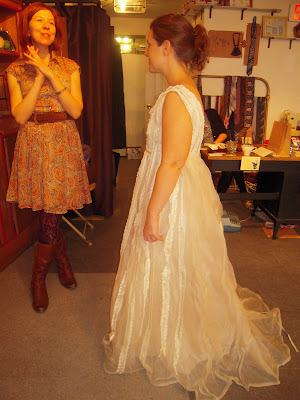
Side-view with Erin, the fabulous designer!
I still have one or two more fittings to go. Along with my mom, my friends Nyka and Anne Marie came for the second fitting. A huge thank you to them for being amazing friends!
Stay tuned for the next fitting!
Friday, April 22, 2011
Dehumanizing work
This week, Tom Philpott, Grist Magazine's senior food and agriculture writer, covered the latest Mercy for Animals (MFA) video to surface from an undercover investigator working at a cattle farm --- this time at a Texas calving operation for the dairy industry.
The video shows in gross and intolerable detail the unspeakable cruelty to baby cows. Philpott aptly observes that MFA and the Humane Society's constant coverage of these types of operations demonstrates that "...animal abuse is a feature, not a bug, of factory farming."
My question is why is this cruelty a feature and not a bug? What makes people abuse these animals in unspeakable ways? Surely the factory farming industry doesn't seek out people who have "enjoy abusing animals" listed under their hobbies right next to "crossword puzzles" on their resumes. So what is it?
This is where my background in genocide studies comes in handy.
While receiving my Masters in Genocide Studies, one of the issues I was interested in was why do normally good people do terrible things (ie: the Rwandan neighbor who becomes a murderer in the midst of a genocide)? Or why does a perceived-evil person save lives (ie: the reformed Nazi Oskar Schindler)?
Throughout my studies, I read a lot of materials from seasoned sociologists, psychologists and historians on how people "become evil." One of the best answers I could find was in an experiment where "normal" Americans were put in a situation and essentially assumed the role they were given. The infamous Zimbardo Prison Experiment attempted to examine prison life, and what was supposed to last two weeks, had to end after only six days due to sadistic behavior from the participants who were expected to play the role of the "prison guards." If this sounds familiar, it is because the photos from this scary scenario look just like those taken in real life at Abu Ghraib.
Other examples I found compelling were the memoirs and accounts I read and heard from survivors of genocides (not just victims, but perpetrators and bystanders as well). Once upstanding and civic-minded Jews in Europe were confined to a ghetto, they took on criminal behaviors that were the result of starvation and humiliation. Likewise, young men enlisted into the police battalion were ordered to kill innocent civilians during the war and they did so.
Were these people born to kill? Were they born sadistic? Numerous studies demonstrate that they were not. Rather, they became killers, criminals, or sadistic individuals as a result of surrounding events and their circumstances.
So what is it about factory farms and consolidated slaughterhouses that cause ordinarily good people to commit such horrible abuses of animals? (Please note that many slaughterhouse and factory farm workers in the U.S. are immigrants who came from their homes in other countries to work in the United States.)
I think the cruel behavior of factory farm and slaughterhouse workers comes from a combination of the above-listed examples. In The Omnivore's Dilemma, Michael Pollan writes,
According to a Reuters article that highlights the research and work from Fast Food Nation author Eric Schlosser, these jobs are often, but not always, performed by illegal immigrants who don't have access to health care or legal advocates. And because many workers don't speak the same language, and turnover is roughly 100 percent annually, unionizing is nearly impossible. Injuries are prevalent due to the pressure to produce more food at lower cost, while the workers are actually making less.
And a 2004 report by Human Right Watch, Blood Sweat and Tears, found that:
Are these workers evil? Are the USDA Inspectors who watch, inspect and ultimately approve of this cruelty also evil?
I don't think so, but I know the system is. And until we start giving the people the rights, respect and compensation they deserve for taking a life to feed others, they will continue to do unto others as they have done unto them.
The video shows in gross and intolerable detail the unspeakable cruelty to baby cows. Philpott aptly observes that MFA and the Humane Society's constant coverage of these types of operations demonstrates that "...animal abuse is a feature, not a bug, of factory farming."
My question is why is this cruelty a feature and not a bug? What makes people abuse these animals in unspeakable ways? Surely the factory farming industry doesn't seek out people who have "enjoy abusing animals" listed under their hobbies right next to "crossword puzzles" on their resumes. So what is it?
This is where my background in genocide studies comes in handy.
While receiving my Masters in Genocide Studies, one of the issues I was interested in was why do normally good people do terrible things (ie: the Rwandan neighbor who becomes a murderer in the midst of a genocide)? Or why does a perceived-evil person save lives (ie: the reformed Nazi Oskar Schindler)?
Throughout my studies, I read a lot of materials from seasoned sociologists, psychologists and historians on how people "become evil." One of the best answers I could find was in an experiment where "normal" Americans were put in a situation and essentially assumed the role they were given. The infamous Zimbardo Prison Experiment attempted to examine prison life, and what was supposed to last two weeks, had to end after only six days due to sadistic behavior from the participants who were expected to play the role of the "prison guards." If this sounds familiar, it is because the photos from this scary scenario look just like those taken in real life at Abu Ghraib.
Other examples I found compelling were the memoirs and accounts I read and heard from survivors of genocides (not just victims, but perpetrators and bystanders as well). Once upstanding and civic-minded Jews in Europe were confined to a ghetto, they took on criminal behaviors that were the result of starvation and humiliation. Likewise, young men enlisted into the police battalion were ordered to kill innocent civilians during the war and they did so.
Were these people born to kill? Were they born sadistic? Numerous studies demonstrate that they were not. Rather, they became killers, criminals, or sadistic individuals as a result of surrounding events and their circumstances.
So what is it about factory farms and consolidated slaughterhouses that cause ordinarily good people to commit such horrible abuses of animals? (Please note that many slaughterhouse and factory farm workers in the U.S. are immigrants who came from their homes in other countries to work in the United States.)
I think the cruel behavior of factory farm and slaughterhouse workers comes from a combination of the above-listed examples. In The Omnivore's Dilemma, Michael Pollan writes,
"...Slaughter is dehumanizing work if you have to do it every day." TempleThe fact that workers are exposed to mass death every day, coupled with the very nature of their job, leads to a cruel and demoralizing situation.
Grandin, the animal-handling expert who's helped design many slaughterhouses,
has written that it is not uncommon for full-time slaughterhouse workers to
become sadistic.
According to a Reuters article that highlights the research and work from Fast Food Nation author Eric Schlosser, these jobs are often, but not always, performed by illegal immigrants who don't have access to health care or legal advocates. And because many workers don't speak the same language, and turnover is roughly 100 percent annually, unionizing is nearly impossible. Injuries are prevalent due to the pressure to produce more food at lower cost, while the workers are actually making less.
And a 2004 report by Human Right Watch, Blood Sweat and Tears, found that:
Because many of the workers are undocumented or have family members who areI often asked myself during my studies if I could be capable of killing. While I repeatedly told myself I wouldn't and couldn't, numerous sociologists and psychologists say otherwise. And I was talking about people. Imagine if it were animals.
undocumented, fear of drawing attention to their immigration status prevents
workers from seeking protection for their rights as workers from government
authorities.
Meat and poultry industry employers take advantage of
these fears to keep workers
in abusive conditions that violate basic human
rights and labor rights.
Are these workers evil? Are the USDA Inspectors who watch, inspect and ultimately approve of this cruelty also evil?
I don't think so, but I know the system is. And until we start giving the people the rights, respect and compensation they deserve for taking a life to feed others, they will continue to do unto others as they have done unto them.
Tuesday, April 19, 2011
Big Cheese Truck: Comfort food for the humane eater
Last weekend, I went to Popapalooza, a Spring kick-off that featured Pleasant Pops (hence the name), music and games (yes... Alex, Winston and I manned the Plinko board).
Another food truck was also there: the Big Cheese Truck, a totally vegetarian grilled cheese food truck. Ordinarily, I avoid cheesy goodness when eating out, because most of the time it is factory farmed cheesy goodness.
Not so this time. It turns out that the Big Cheese Truck gets all their cheese from Cowgirl Creamery near Metro Center in DC (Cowgirl only sells either artisan cheeses from the U.S. and Europe or cheese from small organic farms).
You can even look up specific cheeses the Big Cheese Truck uses for each sandwich on their website, and find out about the cheese and the farm. Or you can just ask them at the truck, like I did.
The Big Cheese Truck gets their bread from Lyon, a local bakery in South West DC.
As I write this now, I really want one of their delicious grilled cheeses. At Popapalooza, I had their "Barely Buzzed" which is cheddar on sourdough. Also as I write this, I realize how foolish it was to do so during Passover.
Maybe this is how I will celebrate leavened bread next week?
Be sure to follow the Big Cheese Truck on Twitter and Facebook and try them for yourself!
Another food truck was also there: the Big Cheese Truck, a totally vegetarian grilled cheese food truck. Ordinarily, I avoid cheesy goodness when eating out, because most of the time it is factory farmed cheesy goodness.
Not so this time. It turns out that the Big Cheese Truck gets all their cheese from Cowgirl Creamery near Metro Center in DC (Cowgirl only sells either artisan cheeses from the U.S. and Europe or cheese from small organic farms).
You can even look up specific cheeses the Big Cheese Truck uses for each sandwich on their website, and find out about the cheese and the farm. Or you can just ask them at the truck, like I did.
The Big Cheese Truck gets their bread from Lyon, a local bakery in South West DC.

As I write this now, I really want one of their delicious grilled cheeses. At Popapalooza, I had their "Barely Buzzed" which is cheddar on sourdough. Also as I write this, I realize how foolish it was to do so during Passover.
Maybe this is how I will celebrate leavened bread next week?
Be sure to follow the Big Cheese Truck on Twitter and Facebook and try them for yourself!
Logo Courtesy of the Big Cheese Truck's website
Subscribe to:
Posts (Atom)